Whilst going around Northern Quarter taking photos and drawing images, I used a rang of cameras. I have taken my first set of photos on a Fujifilm digital camera, these have been useful for drawing purposes. The second set have been taken on a Olympus film camera.
These have come out very different, some are in clear focus, some have been effected by the sun and others have been over laid. The last photo I took was on my Polaroid camera in silver tones. This was a bit over exposed but the outcome is fairly interesting and could make a good print.
4.22.2012
Northern Quarter
My work for this project is based around the Northern Quarter in Manchester. I have been visiting there a lot and looking for inspirational things to inspire my work. A lot of the old architecture and street art has caught my eye. It is a very unique place with a lot of character. There are many small galleries hidden down back streets and tucked under cafes. I have been viewing a lot of Manchester based art and trying to collate a good understanding of what the artists are trying to convey from this place.
Doing research online has also benefited my understanding of this area. I know that the area was a strong point in the industrial revolution, which is clear when walking around all the warehouses and old buildings. These have been converted into studio spaces, vintage shope and record places. One of my favourite places is a little craft centre, which is an old fish market that has been converted. These spaces have been rented for independant artists, allowing them to sell their work and also allowing the public to observe how they create their pieces.
This video is a good visual back up for the information I have found, showing some of the places around Northen Quarter that I have been interested in. The first half focusses on the art and music side of the area. It shows the art and talks about the scene of this part of Manchester. The more research I do into this place, the more of an identity it is having. Its very cultural based and filled with hidden pockets of art and textiles.
3.11.2012
Museum of Science and Industry
2.20.2012
Reflective Blog Entry
The work I have produced for this project has been a lot better interlinked then my previous projects. I have continuously worked with drawing and stitch work to compliment each other. I have noticed the connections between my stitch style and my drawing style as my project progressed. I starting off by throwing myself into stitch work and letting the processes influence my work. I feel this was the main basis behind my work. From working mainly with the straight foot and tailor tacking foot, my work has become very linear and layered. With my original image being a complex mix of layers and colours, it was hard to work with. There was no obvious colour pallet or shape. This also allowed me the freedom to interperate the image the way I wanted to.
My work developed into a series of linear pieces. I used the colour ratios from my image to create the grounds to apply my stitch work to. With the colours being bright I used bright rayon yarns to contrast to them. I found that the satin stitch was the most successful, due to the yarns being so close together it created strong lines across my work. As the fabric grounds were structured to long strips, this created a theme throughout my work. It has a very strong linear feel to each piece, allowing them to relate to each other, though one piece was in grey style.
When working on fabric and also in paint, I found that I subconsciously created work that was in a similar style. Doing the drawing task of making my own utensils really helped my work. I was quite dubious about starting the process, but the patterns I made have helped in my project massively. The way I applied the paint to my paper was very similar to the way I applied stitch to my work. Both were linear and layered with colour. Away from the drawing class I carried on experimenting with the new utensils I had made. I focussed more on the colour pallet that I was using for the rest of my project. I feel that these samples in my sketchbook work a lot better then the larger ones, as they are more confined and detailed.
This project has made me realise that I like working within boundaries. I feel that I need to add detail to the set place and my focus is also a lot better. After visiting the Cube gallery I became more focussed on boundaries and the space in which they were created. The strips of fabric worked well as they had a set shape so I could focus on the processes instead of the shape of my work. I also realised that I prefer to work with my sewing machine at home as it is a better environment for me to work in. I feel more creative having my personal things around me, therefore I am less distracted and can spend longer on my work.
Cube Gallery - January
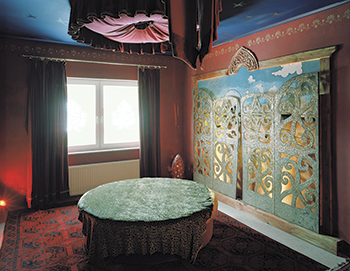
I visited the Cube gallery to look at the new exhibition containing work from Fabien Marques and Jon Spencer. The building itself is very interesting, with the contrast of old brick walls and white plaster boards where the work hung. Though my work consists of mainly fabric and paint work, I was instantly drawn to the photography inside. The first piece that caught my eye were by Marques, a French photographer. The work represented the legal prostitution in Germany. The images were not seedy or shown in a derogatory way. The images were about the absence of the people, suggesting just the spaces in which they worked in. I was drawn to them firstly by their scale and use of bright colours, but then as I continued to look at them the smallest details became interesting to me. The use of space and the canvas sized worked very effectively to Marques.
http://www.cube.org.uk/exhibitiondetails/cubeopen2011exhibition/73
The work by Jon Spencer was also a photography piece. His work however was a series of different photographs to make up one image. He has taken images from Holy Trinity Staircase, Waterloo Bridge and Brent Cross Flyover to create a mythical vision of a place in London. The piece is made up of 72 different images, each being printed to their full size, none of them trimmed down. When I first looked at it, the piece looked like one place photographed from many different angles. As I kept looking I realised that the image was not one place at all, the images don't even remotely fit together. I thought this was an interesting take on perception and space. Each image is a confined space, yet they all come together to create a wider and foreign place.
Subscribe to:
Posts (Atom)